Bespoke build for Cereals host farm
A Househam Harrier equipped with John Deere’s GreenStar precision farming package is being used by 2025 Cereals event host Roy Ward Farms, to meet the farm’s exacting standards for application accuracy and fleet integration. Geoff Ashcroft reports

Roy Ward Farms is now on its fourth successive Househam self-propelled sprayer, though the arrival of its latest model almost didn’t happen.
It had nothing to do with the company’s recent financial troubles, but rather a lack of flexibility from the British manufacturer when it came to precision farming and fleet management integration.
“We’ve recently had a shake-up in the tractor fleet,” explains Andrew Ward, who runs the 605ha family farm alongside his YouTube channel, Wardy’s Waffle, which documents farming life for the energetic Lincs farmer.
“We no longer have a need for a 600hp Case Quadtrac for frontline power, so it made way for a John Deere 8RX 410,” he says. “This opened the door to a whole new precision farming and fleet telematics package, ditching Trimble in favour of GreenStar and MyJohnDeere (MJD).”

He says gaining new-found technology and fleet management quickly became the catalyst for change, with the aim of getting all his prime movers on GreenStar. And that put the farm’s Househam Merlin under the spotlight when the time came to change.
With Househam now based in Woodhall Spa and no longer on his doorstep, Andrew Ward reasoned that other sprayer brands were comfortably within reach, widening his options.
“We could now access Chafer and Sands in the same time as Househam. Both offered a more far flexible approach with machine specification and control systems, where Househam seemed mired in its dated TMC package,” says Andrew.
“I think it woke the firm up a bit, and suddenly, there was a willingness to install GreenStar on the Harrier, as we weren’t the only customer who had asked for it. Along with substantial price difference it meant that as much as I was ready and willing to try a new sprayer, I couldn’t walk away from the savings we’d make over a 10-year ownership period,” explains Andrew

Sat up top, behind the cab, is a StarFire 6000 receiver with a JD 4600 terminal residing in the cab beneath Househam’s tablet-based dashboard. This enables the Harrier to integrate into MJD fleet management and simplify access to maps, field boundaries and 32m tramline locations, as used and shared across other tractors and machinery.
Roy Ward Farms’ machinery fleet overhaul also saw the Harrier arrive with a host of customer-led modifications, which have given the Lincs farmer a much more bespoke solution for liquid applications.
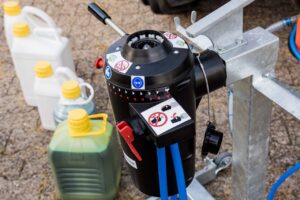
These modifications include a 3in, detachable fill point under the front of the cab with a stainless steel pipe matched to the spray tank profile, stainless steel spray lines within the boom and flexi hoses only at pivot points to lower the cost of replacement pipes.

“It really is one of kind”
Other changes see the steps now folding beneath the cab, a fixed 80in track width using welded steel wheel centres, high-level brake/indicator lights plus four orange flashing LED lights on the rear of the sprayer.
“It really is one of kind,” he says. “The under-cab connection point means we can fill from the bowser without having to fold and unfold the boom. With 1000-litre/min fast fill on the bowser, that’s a transfer time of five minutes total, including coupling and uncoupling.

Cropping at Roy Ward Farms includes 184ha of winter wheat, 53ha of sugar beet, 49ha of spring barley, 13ha of baked beans, 211ha of stewardship and SFi, plus 51ha of grassland allocated to the 2025 Cereals event.
Field sizes range from 6ha up to 25ha, and land is not ring-fenced, so road travel and logistics feature heavily. It is why the farm operates with a 17,000-litre bowser, accessing fill points as required. Rainwater harvesting features heavily at Glebe Farm, with three tanks offering a total of 86,000 litres of storage, while a 10,000-litre, mains-fed tank resides within the enclosed filling area, above the chemical store.

Bowser back-up
“Bailey Trailers created the bowser, using an ex-milk tanker body on an 18t chassis. This offers a 5,000-litre front tank and 12,000 litre rear tank, each with their own dry sight gauges, plus a platform to carry an IBC.”
“At the rear, the standard milk tanker set-up has a generous compartment where the petrol-powered pump and the valves are located, along with 3in pipes throughout, all plumbed by Househam,” he explains.
In addition, an induction hopper slides out at the rear of the bowser and the tanker body includes an integral fold-down catwalk and rear step ladder, improving safety when access to the tank compartments is required.
Bowser operator Tom Hyland and sprayer operator Reuben Sampson say that when pre-mixing, the combination has enabled them to blitz 350ha/day, using a water volume of 100 litres/ha.

Twin nozzle bodies
Cost is one of the reasons the farm has not adopted Pulse Width Modulation (PWM), but instead chose Hypro Duo React twin nozzle bodies. These are said to give the benefit of twin line functionality, and for Glebe Farm, it provides the flexibility to install dribble bars on one, and a selection of spray nozzles on the other.
“I have been using Guardian Air nozzles with great success, but the opportunity to choose new nozzles for the Harrier led us to try the Lechler’s IDTA 03,” says Reuben. “These double flat-fan air injection nozzles have been a game-changer for me. The coverage is superb.”
Reuben’s other nozzles include 03 Guardian Air, 05 and 025 Defy – the latter are used for sugar beet.

“Boom stability is at best, mediocre. Fortunately, we farm on relatively flat fields, so I can do a better job manually, than let the integral boom height sensors try to do their thing,” Reuben adds. “And since we’ve had the steel boom rebalanced, it is much more stable and far easier to control.”
“Great tyres”
The lack of steep slopes has also steered Andrew Ward and his team to make specific choices with low ground pressure tyres. The Harrier’s 710/50 R26.5 Trelleborg Twin Radial tyres are boots with which Andrew has past experience.

“Great tyres, and one set spanned the life of two sprayers,” he says. “The Trelleborg Twin Radial has a shallow 25mm lug depth so it doesn’t dig, and a central block tread. We don’t need extreme traction, because we don’t climb steep banks, but we do want full tread width on the ground – and you don’t get that with a lot of 710’s.”
The set fitted to the Harrier had been sat around in Househam’s yard, and were around 10% worn.
“We had them fitted to wheels that used welded centres and our only criteria was having a fixed track width of 80in to suit the row crop tyres and our tramlines,” says Andrew. “I didn’t want the cost or complexity of hydraulic track width adjust, which would seize if you didn’t use it enough.”
“As long as we had a minimum of 2in clearance between the inside of the 710 tyre and the frame – as determined by the position of the welded centres – we didn’t worry about where these wide tyres ran on the crop.”
He says 16psi is used in-field with the 710’s, and the footprint is ideally suited to running in sugar beet.
“We tramline our beet, and that means the LGP tyres do run on two rows – inner and outer edge of the tyre,” he says. “But these are so kind on the ground that crop damage is non-existent.”

With the Harrier and its GreenStar integration well and truly ticked, the next phase of operational efficiency is to find an alternative solution to resolve the lack of transfer speed, when pulling data into Gatekeeper.
“I’ve spent thousands getting WiFi all around the yard, so that all our kit automatically connects on its return to base to upload work sheets and application data to the cloud,” he says. “Yet Gatekeeper can’t handle the increased data we’re now collecting from MJD and downloading this into Gatekeeper takes hours instead of minutes. And, frustratingly, that means it’s still quicker to mess about with bits of paper.”

Farm Facts
Business: Roy Ward Farms, Leadenham, Lincs
Cropping: 605ha comprising winter wheat, sugar beet, spring barley, baked beans, stewardship and SFi
Staff: Two full time, plus harvest help as required
Sprayer: Househam Harrier 4,000 litre/32m self-propelled, with 17,000 litre bowser