Hit grass weeds early
Research by NIAB and Syngenta shows attention to detail and timing will help improve weed control in the spring. Operators will also need to be prepared to select the right nozzle and rate to hit the target as the season progresses.
Going into the spring, farmers, agronomists and sprayer operators face the prospect of contending with high weed populations of wild oats, ryegrass and some brome species, as well as larger plants to contend with.
Research, however, reveals the overwintered and earliest emerged grass weeds have the greatest competitive effect on crop yields, as well as producing far higher numbers of viable seeds to perpetuate weed problems in future years.

Don’t hold off
NIAB research confirms advice to target spring grass weeds as early in the season as possible. While there may be a temptation to delay treatment to allow later germinating grass weeds to come up, trials show these later emerging weeds pose far less threat to the crop and produce a much lower seed return at maturity.
Holding off grass weed treatments will result in more competition on crop yields and could prove more difficult to control – requiring higher herbicide rates and a greater challenge for application.
Treating wild oats and ryegrass as soon as weather conditions enable consistent plant growth from the start of February. Good growth of target weeds is important to translocate the herbicide active down into the root and achieve a complete kill.

Another good reason for applying early is that weeds are easier to target and hit with the spray while the crop is still relatively small and open.
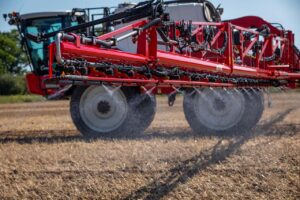
Syngenta research shows, with the early Axial Pro (Pinoxaden + Cloquintocet-mexyl) treatments, using the 3D angled nozzle is most effective at hitting and retaining spray on the target grass weeds. Applying in a water volume of 100 litres/ha with the 3D nozzle can ensure good coverage of the leaf, but without over wetting surfaces and leading to run off.
Where crops have tillered and are larger at the time of application, however, the grass weeds may be shielded from the spray. In these situations, it’s recommended to use the more upright spray pattern of an Amistar (GuardianAir) nozzle, to get more spray down into the canopy, and increase water volume closer to 200 litres/ha.

Control the pressure
Do not increase spray pressure in an attempt to ‘push’ the spray into the canopy. It is actually counterproductive, because the higher pressure creates a greater proportion of fine droplets, which are less able to penetrate the crop canopy and are at risk of being lost as drift.
Using a larger sized nozzle or drift reduction technology at a slower speed will apply the required water volume more consistently and effectively.
Treating overwintered wild oats, for example, up to growth stage 29, an Axial Pro rate of 0.6 litres/ha is advised in good growing conditions, increasing up to the maximum 0.82 litres/ha where growing conditions are compromised. For larger weeds, up to growth stage 39, and for all ryegrass treatments, the higher rate of 0.82 litres/ha would be the default.
Each field’s weed burden needs to be individually assessed. Broad-leaved weeds are usually easier to control later in the season, without the same fears of crop competition and weed multiplication associated with grass weeds.
Tank mixing with a compatible broad-leaved herbicide can achieve a complete spring clean-up of weeds in a single spray, which reduces time and cost.

Stick to the sequence
Operators do need to be aware of stipulations with herbicide sequences. Using Axial Pro first in a herbicide sequence that includes SU/ALS or hormone broad-leaved weed treatments, for example, ensures the grass weeds can be taken out at the optimum time. This is compared with a 21-day interval required after a ALS/hormone herbicide has been used before the grass weed control can be applied.
Earlier targeting of wild oats, ryegrass and other grass weeds does give the flexibility to achieve control at lower application rates and increases the likelihood of better control overall. But as weeds increase in size, or where spring application conditions are less conducive, the rates may need to be increased accordingly.

Axial Pro can be applied at full rate right up to GS41 in wheat and barley. This compares with GS31 and at a capped rate with fenoxaprop in barley, for example.
With these late season applications, where weeds are still within the crop using the Amistar (GuardianAir) nozzle is the best option, however when weeds have risen above the crop it’s recommended operators revert to an angled 3D nozzle at 100 litres/ha to best target the exposed leaves.