
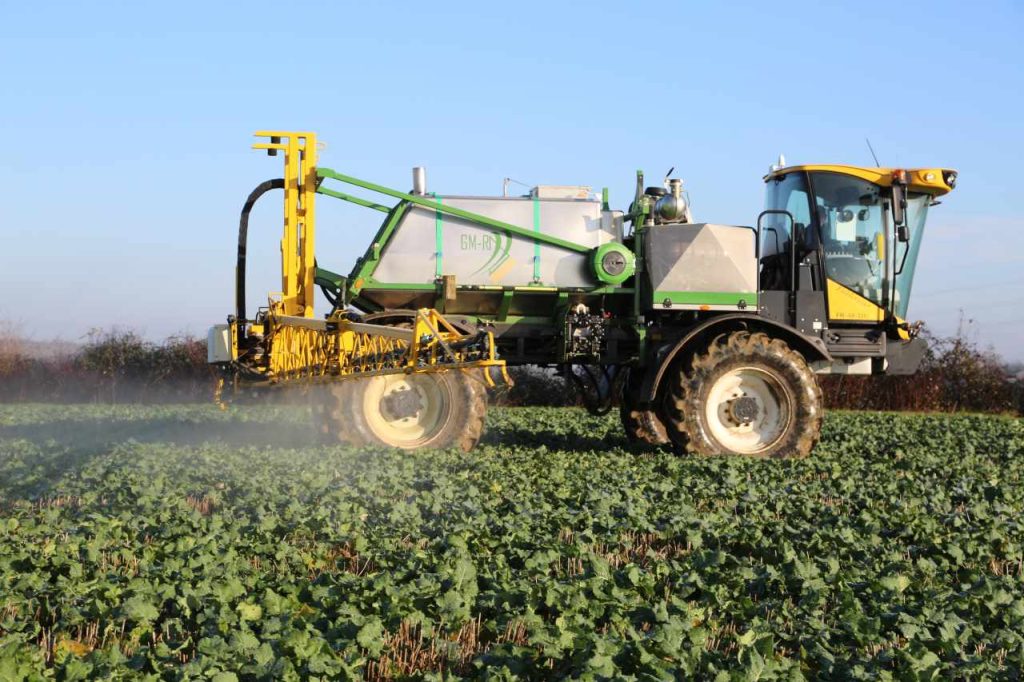
Operators are being urged to closely follow stewardship schemes this autumn. While it’s imperative that sprayer operators ensure autumn herbicides are kept of out of water, it also makes good agronomic and economic sense, reports Teresa Rush.
With the launch of the Voluntary Initiative (VI) in 2001, along with several manufacturer-led schemes introduced in the late 2010s, voluntary stewardship is playing a key role in protecting water.
In some cases, it has even helped prevent use restrictions or outright bans on active substances – a key consideration as the herbicide toolkit shrinks as a result of regulation, resistance and a slowdown in the development pipeline.
Most recently the on-farm spotlight has shifted towards preventing nutrient pollution in watercourses. But best practice for plant protection products is just as important – keeping pesticides out of water remains a critical challenge.
Much of the information provided in the past ten years, remains relevant today says VI operations director Dr Neal Evans.
“The VI’s ‘Think Water ‘campaign (launched in 2016) originally covered the five main autumn oilseed rape herbicides in use at the time: propyzamide, metazachlor, quinmerac, clopyralid and carbetamide.
“Carbetamide is gone now but more recently we’ve noticed cereal herbicides, such as flufenacet, starting to become more prevalent in water testing results, so the campaign has been widened out to include not just oilseed rape herbicides but cereal herbicides as well,” says Neal.

Environment Agency data shows that bentazone (the herbicide active substance in Basagran SG and other products) is the most commonly detected approved pesticide in UK groundwater. It is also increasingly being found in surface water, potentially putting renewal of its approval for use at risk.
Pesticide contamination of water is not just a problem in arable areas. In the predominantly livestock farming areas in the west of the UK MCPA, mecoprop and 2,4-D are frequently detected in untreated water.

Think Water
‘Think Water’ helps explain the route than plant protection products (PPPs) can take to water,” says Neal.
A range of resources is available on the VI website, but underpinning the campaign are three key steps, he adds.
“The first is to use the Environment Agency’s farmers’ page, which will tell you whether your land is in a Drinking Water Safeguard Zone.
Environment Agency website
“The second is speak to your local water company catchment officer or catchment sensitive farming officer who can help you understand the potential risk on your farm on a field-by-field basis or speak to your BASIS qualified agronomist.
“The third step is to implement best practice agronomy to help protect water.” You can read more about these initiatives on the VIs Think Water below:
Blackgrass herbicides
In cereals and oilseed rape, controlling blackgrass is a key driver for autumn and winter herbicide applications, but the risk of these entering water is higher during this period, and they are among the most frequently detected in watercourses.

Propyzamide (in Kerb Flo, AstroKerb and other products) is persistent and difficult to remove from water and probably gives water companies most cause for concern at present, says Richard Reynolds, senior agronomy adviser at Anglian Water and chair of Water UK’s water catchment network. Contamination problems can, however, be very localised, he adds.
“For instance, propyzamide is a particular challenge at our Pitsford reservoir in Northamptonshire, where higher than usual levels have been detected, whereas at other sites it is less of an issue,” he says.

Richard suggests farmers and growers think about pesticide losses to water in the context of a stock take – herbicides lost to water are not reaching their intended target, the efficacy of the application is diminished and there is an associated cost.
“If we see these products in water, it means they aren’t on the land doing the job that they need to be doing,” he says
Knowledge hub
Propyzamide manufacturer Corteva has recently launched a new Propyzamide Knowledge Hub, providing advice on what propyzamide is, how it works, how to apply it for the best outcome and practical advice on how to use it responsibly.
You can find the Propyzamide Knowledge Hub in the link below:
Central to Corteva’s advice to growers and sprayer operators is a simple principle: apply the right rate, under the right conditions, at the right time.
“This is to ensure the best efficacy as well as making sure the product stays where we need it – in the field, controlling weeds,” says Corteva’s Clare Stapley.
Grant schemes
In addition to the considerable amount of stewardship advice available, there is further support on offer in the form of grant aid from a range of sources.
Several water companies operate grant schemes – contact your local water catchment officer for information on what’s on offer in your area.
Anglian Water operates a Farm Innovation Grant Scheme, designed to support innovation in identifying local solutions to local water quality challenges in priority catchments across the Anglian Water region.

Essex & Suffolk Water/Northumbrian Water have just announced a new round of ‘Field to Tap’ funding. The scheme will focus on four key areas: in the yard, in the field, soil health and farming precisely, in catchments with identified water quality issues, says catchment adviser Stephen Derbyshire.
“We welcome approaches from any farmers who think that they may have opportunities to improve the quality of water leaving their farms,” says Stephen.
Catchment Sensitive Farming (CSF) also offers capital grants for farm infrastructure and water quality projects, although the Government announced on August 1 that its capital grant funding for 2025 had been fully allocated. A further round of funding will be available in 2026.
Pragmatic approach
David Felce farms 96ha of combinable cropping and spring-sown legume fallow (NUM 3) at Midloe Grange in Cambridgeshire. He is also an agronomy and spray application consultant and, until recently, was a regional technical adviser with Agrii.

He operates a labour and machinery sharing agreement with a neighbour, who currently carries out the spraying across the two farms with a 36m Hardi Alpha self-propelled sprayer.
With water draining from the farm into Anglian Water’s Grafham Water reservoir via two SSSIs (Sites of Special Scientific interest), keeping herbicides out of water has been a long term focus.
A keen proponent of Integrated Pest Management (IPM), David adopts a pragmatic approach to keeping herbicides out of water.
“With grassweeds almost ubiquitous now and levels of resistance in herbicides increasing, we’ve had a loss of actives, not only in terms of losing products, but reduced efficacy of contact graminicides.

“But having done all the cultural controls, you are inevitably left with having to use herbicides. And it is almost inevitable that there’s going to be a problem, because when you look at what you want to do to grow a good crop of oilseed rape, for example – i.e. promote drainage and room for the roots to grow down – it’s remarkably similar to the conditions likely to provide propyzamide with a potential route to water,” he says.
David recommends Water Protection Advice Sheets (WPAS) available on the VI website as a good place to start for advice on keeping herbicides out of water, which you can access from the VI’s website here:
More widely, he highlights work conducted by Agrii in Poland, which showed some adjuvants can play a useful role in retaining herbicides in the upper soil profile, resulting in less wash-down to lower layers and drains.
With spray drift a potential source of water contamination, further options to consider might include use of Drift Reduction Technology (DRT) nozzles or angled nozzles, he adds.

“All the basics of good spray application – including the right water volume, forward speed and boom height – still hold true and are definitely things to get right, and an appropriate adjuvant can help as well,” says David.
Water protection
In the 12 months between February 2024 and February 2025, 4,026 arable farmers completed the VI IPM plan. Of these, 3,951 responded to a question asking about actions they took to protect water courses from PPPs.
The results highlight the role of good spray handling and application.


