Nearly half of all machines entered for their annual NSTS test fail the first inspection, but following some simple repairs 99% pass, says Ian Forman, NSTS manager.
Well maintained and adjusted sprayers improve application accuracy and reduce the risk to the environment. Moreover, this helps prevent waste, ensuring the crop receives the maximum benefit from costly crop protection products.
“The NSTS test is not a service, therefore any faults found on the sprayer presented for test need to be recorded as a fault and rectified accordingly. What is concerning is that consistently the top five or six faults we find on all types of sprayers are related to leaks, drips and filters. This means the machine is not only applying products inaccurately it is potentially polluting the environment,” explains Ian.
Don’t leave it for an NSTS engineer to find, says Ian. “Every operator is capable of spotting and fixing all these faults. Indeed, it is their responsibility to ensure equipment is functioning properly and these types of problems are easily found during a quick look around the sprayer every day.
“Looking at the top ten faults, most of the issues will still have a significant impact on accuracy and reliability. But, again, they are easy to spot and rectify, adds Ian.
Don’t leave it for an NSTS engineer to find, says Ian. “Every operator is capable of spotting and fixing all these faults. Indeed, it is their responsibility to ensure equipment is functioning properly and these types of problems are easily found during a quick look around the sprayer every day.
“Looking at the top ten faults, most of the issues will still have a significant impact on accuracy and reliability. But, again, they are easy to spot and rectify, adds Ian.
Air-blast sprayer faults
NSTS engineers find similar faults on orchard sprayers, with the top ten featuring even more simple to fix problems but, most worryingly, lack of proper guarding on 21% of the machines.
Operator check sheet
NSTS produces a Operator Check Sheet for both boom and orchard sprayers. This provides a useful guide to follow to ensure all main points are inspected and nothing is overlooked. Ian suggests if time is tight operators divide the inspection over a few days, rather than do it quickly and miss something important. You can download this here:
Check the top ten
“Most of the faults that regularly feature in the top ten are easy to spot and rectify. They should, however, all be spotted on a quick daily look around the sprayer or during a longer, regular maintenance session on a wet day,” says Ian.
Dripping DCVs, anti-drips and chemsavers consistently feature as number one in the fault parade. Drips are easy to spot and repair by simply replacing the faulty part, which is why it’s important to carry spares.
Free from leaks spraying at 5 bar rarely slips out of the top ten. The test is designed to stress the system to reveal leaks, which are not seen at spraying pressure, but are likely to get worse. This will cut downtime by fixing it before it fails in the field.
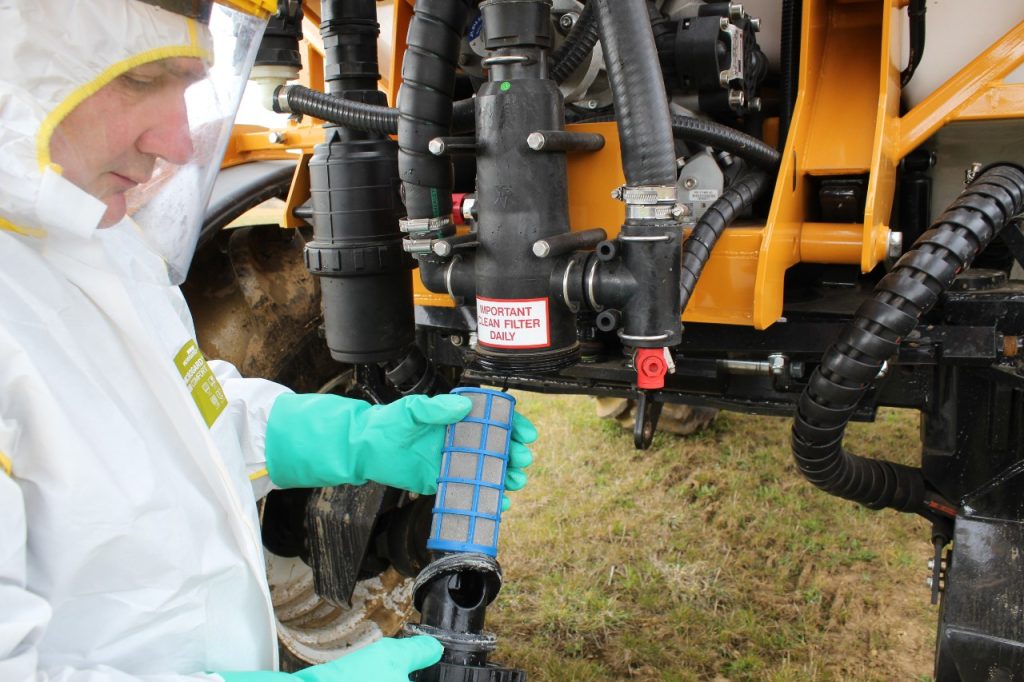
Dirty, blocked or damaged filters are commonly found by engineers. 10% to 15% of all application issues can be traced back to poor filtration, so it’s important to check the suction and pressure filters at least once a week. Also confirm the mesh size is the correct match for the nozzles because, if not, this can inhibit output or lead to more blockages.
Free from leaks, static. Possibly the most indefensible fault to find its way into the top ten. This is something that is easy to see during a quick check around the machine. Repairs are also straightforward.
Hose condition – check all hoses are in good condition – assessing for wear, splits, cracks and kinks. Ensure pressure hoses on booms do not obstruct nozzles in any way.
Contents gauges misted up or missing markings make it difficult for operators to know the precise tank contents.
Pressure gauges – the machine’s gauge must indicate a pressure within +/-10% of the NSTS engineer’s calibrated gauge.
Induction systems must be free from leaks and correctly working, with a mesh above the outlet to stop any object larger than 20mm passing through.
Spray patterns must not be obstructed by hoses or other items. Worn or blocked nozzles will also interfere with the pattern.
Nozzle output
The NSTS Check Sheet also has a section where operators can record nozzle outputs as well as results from a full calibration.
Checking nozzle output is a relatively simple procedure that involves setting the sprayer to the pressure for the required flowrate. This is done simply by using, preferably, a measuring cylinder (or jug) and a stopwatch.
To measure nozzle flowrate, simply collect and measure the volume of liquid that flows through it in one minute. This will reveal the actual flowrate in litres/min. Then compare this output with the manufacturer’s figure for the nozzle at the set working pressure.
To pass an NSTS test the flowrate must be within +/- 10% of the manufacturer’s figure stated on the nozzle charts.
Calibration procedure
Regular calibration is important because:
- It confirms the sprayer is functioning correctly
- Checks each nozzle is delivering the desired rate at the correct pressure (litres/min)
- Ensures the desired rate (litres/min) is applied to the crop
- It also improves coverage, reduces product waste and confirms the application is within maximum product dose rates.
The Operator Check Sheet also has a section to record a calibration. Red Tractor assurance says: ‘Equipment must be calibrated between seasons of use, as a minimum’.
Some operators may think it’s unnecessary to check the forward speed of their sprayer, because it has an automated rate controller. But the difficulty here is that the controller will automatically adjust the output regardless of nozzle wear or other problems and there’s a range of reasons why it could be incorrect.
The calibration requires an accurate forward speed to be measured and this involves measuring the time (in seconds) it takes for the machine to cover 100m. For precise results do this with the tank half full and from a rolling start.
There is a formula on the Operator Sheet to convert the speed over 100m to km/h. Once calculated this can be used, along with your recorded nozzle output, to calculate the actual output in litres/min.
