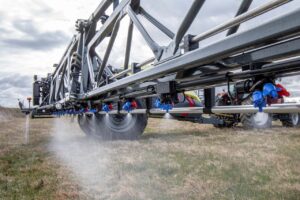

Pulse width modulation explained
With its ability to turn nozzles on and off up to 100 times a second, Pulse Width Modulation (PWM) not only maintains the right application rate, but also the correct droplet size, regardless of changes in forward speed.
At the same time, if equipped with individual nozzle control, and many systems are, it will provide ‘turn compensation’. This will reduce or even eliminate the over- and under-application caused by the inside of the boom hardly moving, while the outer end whips around when cornering.
These poor applications on corners result in inferior control. Worst still, it is now becoming quite obvious that years of sub-lethal treatment contributes to herbicide resistance in these areas, exacerbating the weed control problem.
How PWM works
In normal situations the output of a nozzle is fixed and determined by the orifice size and the pressure. If the sprayer speeds up or slows down the only way to change the flow is to alter the pressure to maintain the set application rate.
Automatic rate controllers will change the pressure to match speed changes. But the difficulty with standard nozzles is to double the flowrate you need to increase the pressure by a factor of four. This will inevitably alter the size of the droplet, coarsening them as you slow down or making them finer as you speed up – increasing the risk of drift.

Pulse frequency
PWM overcomes this problem by essentially maintaining the application rate by using solenoids to turn the nozzles on and off in milliseconds. The actual switching speed – or pulse frequency – is rated in hertz (Hz) – if the nozzles can be pulsed at up to 100 times/sec this is shown as 100Hz.

Duty cycle (DC)
Another important parameter is the ‘Duty Cycle’ – this is the ‘pulse width’ part of the name and denotes the length of time the solenoid is open and the nozzle is spraying. This can range from 10% – open for just a tenth of the time – up to 100%, or fully open.
Experts recommend setting systems to operate at between 60% to 80% DC. To do this operators need to select a nozzle for optimum droplet size for the target and essentially add about 20% to 40% more flow compared with the normal size. This forces the system into running most of the time at 70% DC, which allows room to move in either direction.

Forward speed changes
At 70% DC the system can operate 30% faster – for example when speed increases to say 16km/hr taking it up to 100%. Or, when slowing down to about 4km/hr, it is able to drop to 20%. This will determine the working speed range over which the pressure remains constant and consequently the droplet size will stay the same.
Nozzle selection
For any nozzle, the pressure determines the droplet size, and the benefit with PWM is that’s held constant. The key is to select a nozzle for optimum droplet size for the target and, importantly, that will work within the duty cycle parameters.
It’s important to note that, due to the temporary break in spray pressure during the off-cycle, PWM doesn’t work well with air-inclusion nozzles.
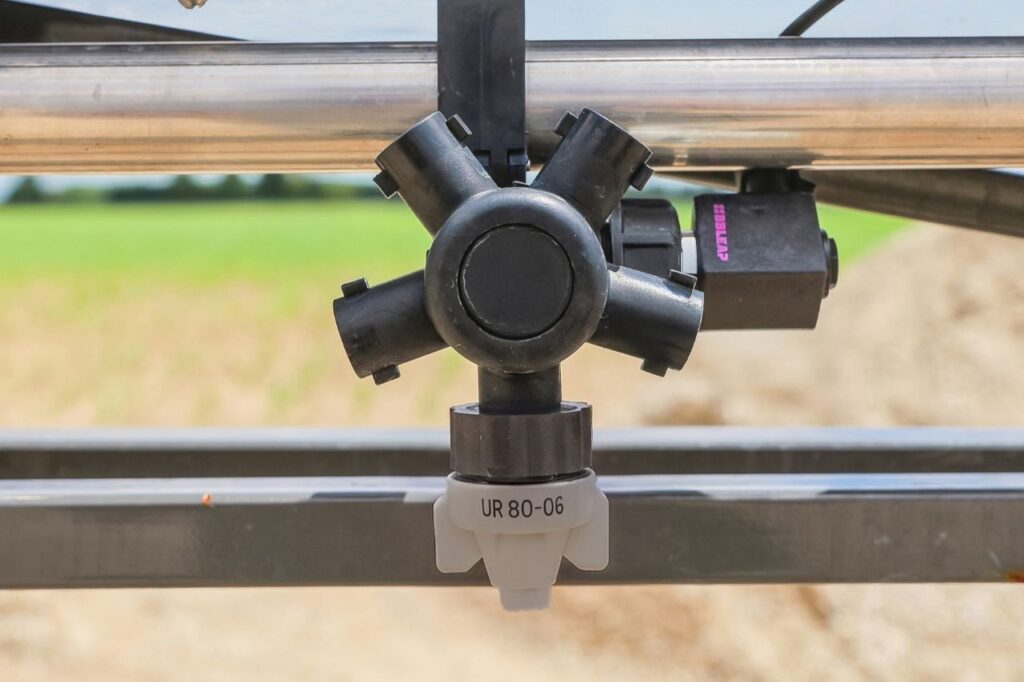
Turn compensation
With turn compensation, sensors monitor the differences in speed the boom is travelling when making a turn. These detect the boom tips will be whipping around the outside of a corner, while the inner section hardly moves – or even goes backwards.