Top tips to tackle blackgrass
Applying crop protection products in the autumn is a race against the weather.
Good preparation and best practice before and during autumn spraying operations can have a significant effect on application efficacy.
Where grass weeds are a problem, delayed drilling is perhaps the most important tactic in the armoury of options. The later the crop is drilled, the lower the challenge of grass weeds within the crop, but delay too long risks getting the crop in before the weather worsens. The greater the farm’s capacity to swiftly complete autumn work, the more flexible it can be with its timings.
Field Preparation

Straw:
The less trash there is on the surface, the better the crop protection products will perform Syngenta research shows trash on the surface reduced herbicide efficacy by 12% to 20%, compared with baled straw.

Rolling:
The smoother the seedbed, the less shadowing there is from clods, resulting in a more uniform application of herbicides, which results in improved performance. Rolling also encourages grass weeds to germinate before spraying off with glyphosate, prior to drilling.
Timing:
Of all the possible variables governing application success it’s timing that has the biggest effect on the end result. There is general agreement from spray manufacturers that pre-em herbicides should be applied within two days of drilling, and post-em foliar applied herbicides should be applied as soon as the crop reaches the two-leaf stage, which will be the one to two-leaf stage of the blackgrass.

Filling routine:
A typical spray load is 3 litres/ha of product. For a 4,000 litre sprayer that is 120 litres of product. It takes one minute for an experienced operator to pour and rinse a container. Note that it takes the same time, whether it’s 1 litre to 10 litre containers.
Ordering product in 10 litre packs reduces filling time to 12 minutes compared with 24 minutes for 5 litre packs. This 12 minute saving equates to spraying an extra 9ha with a 36m machine, travelling at 12km/hr.

Water conditioners:
If a Cation Complexer water conditioner is required, for this to work it’s important to treat all the water – before the chemical is added. This allows time for the maximum amount of water to be pre-treated before the chemical is filled as late as possible.
Water volumes:
This can effect the spray timing and efficacy. Consult the Code of Practice for using plant protection products before applications in a water volume below the minimum in the label text. If in doubt contact the product manufacturer’s help line.

The race is on
In the race to get autumn sprays applied as effectively as possible and at the optimum time, there will need to be some compromises.
A key benefit of 100 litres/ha versus 200 litres/ha is an increase of about third more area sprayed/day. A 150ha spray day becomes a 200ha spray day.
Some products, like glyphosate and foliar applied translocated grass weed herbicides, tend to up their performance when applied at 100 litres/ha compared with 200 litres/ha. This is because the reduced volume results in greater deposition and increased uptake on the small weeds.

There is no biological disadvantage from increasing water volumes for soil applied herbicides, provided the timing is not compromised. Syngenta trials show that 200 litres/ha has been more consistent than 100 litres/ha for a range of different nozzle types.
200 litres/ha is the equivalent of 0.02mm of rainfall. For soil applied herbicides, water is simply a carrier for the chemical and is not enough to have an irrigation effect to alter the germination of the weeds. Water volume is significant, however, for sufficient coverage when very large drops are deployed – such as those from 90% drift reduction nozzles.
The number of drops/litre from such sprays is very low, so the gaps between individual droplets on the ground are relatively wide and weeds can grow in between. Best advice from trials is to use a volume of 200 litres/ha when applying soil applied herbicides through 90% Drift Reduction Technology (DRT) nozzles. The advice from all the manufacturers is: ‘Don’t compromise the timing’.
Nozzle selection
For autumn spraying you cannot rely on perfect conditions every day. There is a role for three nozzle types on the sprayer.
The application goal is to maximise the deposition and its uniformity, while avoiding off-target losses. The stronger the wind, the finer the spray, the higher the boom, and the faster the forward speed are the key spoilers. These can all be countered by increasing droplet size. Larger drops are more controllable and tend to go where they were pointing as they left the nozzle.

The patternation performance of a nozzle at different nozzle heights gives a valuable illustration of how uniform the application will be in the field. For approval by the Julius Kuhn Institute (JKI) in Germany, the nozzle should have a co-efficient of variation (CoV) of less than 7% at the datum height, and not more than 9%, 10cm either side of the datum.
Angled sprays increase deposition
Angled sprays are particularly effective in the autumn, increasing deposition on foliar targets, by as much as two times, and if they are deployed alternatively forward and back along the boom, it increases uniformity of deposition in three dimensions on the soil.

Nozzle choice
In ‘Dry’ conditions the Defy 3D is often the preferred nozzle, it is much less drifty than a traditional fan jet, patternates well, tolerates variations in nozzle height, and is consistently the top performer both for pre-em sprays and foliar applied sprays.

For ‘Intermediate’ conditions a small droplet air inclusion (AI) nozzle, such as the GuardianAir is a good option. This produces a large number of droplets/litre, with 75% drift reduction rating and excellent patternation. There is also a small backwards angle to compensate for the forward speed of the sprayer, further increasing the uniformity of deposition.

When it’s ‘Full Wet’ and conditions are very variable 90% drift reduction nozzles are preferred, and should be deployed applying 200 litre/ha.
Optimum sprayer set up:
- Boom perfectly straight
- Boom isolation suspension well maintained
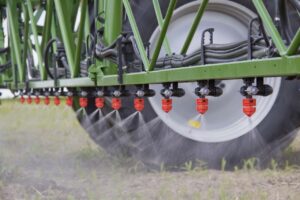
- Nozzle height 50cm above ground or crop
- Cable tie on boom for visual confirmation of nozzle height
- Forward speed 12km/hr
- Nozzle bodies vertical
- Low ground pressure tyres
- Minimum tyre pressure for the maximum load